
Digital Marketing Basics
 . What is Digital Marketing?
-
Defining the Digital Landscape: Briefly explain that digital marketing is any marketing effort that uses an electronic device or the internet.
-
Traditional vs. Digital: Highlight the shift from billboards/print to data-driven, measurable online strategies.
-
Why It Matters: Discuss the ability to reach a global audience, target specific demographics, and measure ROI in real time.
2. The Core Pillars of Digital Marketing
-
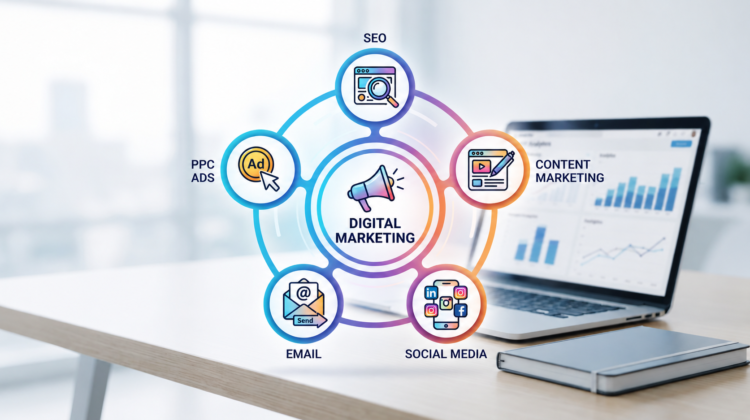
Search Engine Optimization (SEO): Explain how to improve website visibility on platforms like Google through high-quality content and technical site structure.
-
Content Marketing: Focus on the importance of providing value to the audience (blogs, videos, whitepapers) rather than just “selling.”
-
Social Media Marketing (SMM): Discuss building brand awareness and community engagement on platforms like LinkedIn, Instagram, and X.
-
Pay-Per-Click (PPC) Advertising: How paid campaigns provide immediate traffic and why targeting is the key to managing budgets effectively.
-
Email Marketing: Why it remains the most effective channel for customer retention and high-conversion nurturing.
3. Understanding the Digital Marketing Funnel
-
Awareness (Top of Funnel): Attracting strangers to your brand through social media and informative blog posts.
-
Consideration (Middle of Funnel): Providing solutions to problems (e.g., case studies, webinars) to turn leads into prospects.
-
Conversion (Bottom of Funnel): Using landing pages, demos, or limited-time offers to finalize a sale.
4. The Power of Data & Analytics
-
Key Performance Indicators (KPIs): Define metrics like Click-Through Rate (CTR), Conversion Rate, and Cost Per Acquisition (CPA).
-
Tools for Success: Mention essential tools for tracking (e.g., Google Analytics, CRM software, or heatmap tools).
-
Data-Driven Iteration: Explain that the “secret sauce” of digital marketing is constantly testing and refining based on data.
5. Future-Proofing Your Strategy
-
The AI Revolution: Briefly explain how AI tools are automating content creation and predictive analytics in 2026.
-
User Experience (UX): Emphasize that speed, mobile-friendliness, and intuitive navigation are now just as important as the content itself.
-
Privacy & Trust: Discuss the importance of transparency in data collection to build long-term brand loyalty.
6. Conclusion: Building Your First Campaign
-
Actionable Steps: Give the reader 3 things they can do today (e.g., set up a professional social profile, start a basic content calendar, or install analytics software).