
SIP vs FD in 2026: Where Should Indian Salaried Employees Invest ₹5,000 Per Month?
SIP vs FD in 2026: Where Should Indian Salaried Employees Invest ₹5,000 Per Month?
A practical 2026 comparison of SIPs and Fixed Deposits for Indian salary earners who want better returns, lower taxes, and long-term financial growth.
Quick Answer
If you can stay invested for 5 years or more, a SIP in a diversified equity mutual fund generally offers better wealth creation potential than a bank FD. If your goal is capital safety and predictable returns within 1–3 years, an FD is the better choice.
For many Indian salaried employees, ₹5,000 per month is the first serious step toward financial independence. The biggest question in 2026 is whether that money should go into a Systematic Investment Plan (SIP) or a Fixed Deposit (FD).
This guide compares returns, risk, taxation, liquidity, and long-term wealth creation so you can make a confident decision based on your salary and financial goals.
What Is a SIP?
A Systematic Investment Plan (SIP) allows you to invest a fixed amount regularly into a mutual fund. Instead of trying to time the market, you invest every month and benefit from rupee-cost averaging and compounding.
Why SIPs are popular in 2026
- Start with as little as ₹500
- Potential to beat inflation
- Professional fund management
- Suitable for long-term goals such as retirement, home purchase, or children’s education
Learn more from the official SEBI investor education portal: https://investor.sebi.gov.in/.
What Is a Fixed Deposit?
A Fixed Deposit (FD) is a bank investment where you deposit money for a fixed period and earn a predetermined interest rate.
Why salaried employees choose FDs
- Guaranteed returns
- No market volatility
- Easy to open through any bank
- Suitable for emergency funds and short-term goals
RBI regularly publishes banking and deposit-related information here: https://www.rbi.org.in/.
SIP vs FD: Key Differences
| Feature | SIP | FD |
|---|---|---|
| Expected Returns | Market-linked | Fixed by the bank |
| Risk Level | Moderate to High | Low |
| Liquidity | Usually redeemable anytime | Penalty may apply |
| Inflation Protection | Better over long periods | Often limited |
| Tax Efficiency | Can be more efficient for long-term equity investments | Interest taxed as per income slab |
How Much Can ₹5,000 Per Month Grow?
Assuming regular monthly investing for 10 years:
| Investment | Monthly Amount | Assumed Annual Return | Approx. Value After 10 Years |
|---|---|---|---|
| FD | ₹5,000 | 7% | ~₹8.6 lakh |
| Equity SIP | ₹5,000 | 12% | ~₹11.6 lakh |
Total amount invested: ₹6,00,000
The SIP example is not guaranteed, but it shows the power of compounding over a long period.
SIP vs FD for Different Salary Levels
| Monthly Salary | Recommended Option |
|---|---|
| Below ₹30,000 | FD + small SIP |
| ₹30,000–₹60,000 | Balanced approach |
| ₹60,000–₹1,00,000 | SIP-focused strategy |
| Above ₹1,00,000 | SIP + debt allocation |
When Should You Choose an FD?
An FD is usually the better option if:
- You need the money within 1–3 years
- You are building an emergency fund
- You cannot tolerate market fluctuations
- You are saving for a short-term expense such as a vehicle, wedding, or travel plan
When Should You Choose a SIP?
A SIP is generally more suitable if:
- Your investment horizon is 5 years or longer
- You want to beat inflation
- You are investing for retirement, wealth creation, or children’s future
- You can continue investing even during market ups and downs
Can You Combine SIP and FD?
Yes. For many salaried employees, the smartest strategy is a combination of both.
Suggested ₹5,000 Allocation
- ₹3,500 in an equity SIP for long-term growth
- ₹1,500 in an FD or recurring deposit for stability and liquidity
This creates a balance between growth and safety.
Expert Recommendation for 2026
For a typical Indian salaried employee aged 25–40 years with stable income and no immediate need for the money, a diversified equity SIP is generally the stronger wealth-building option.
A Simple Rule
- Less than 3 years → FD
- 3–5 years → Hybrid approach
- More than 5 years → SIP
Voice Search Summary
If you ask, “Which is better in 2026: SIP or FD for ₹5,000 per month?” the short answer is:
SIP is generally better for long-term wealth creation and inflation-beating returns, while FD is better for short-term savings and guaranteed safety. For salaried employees investing for 5 years or more, SIP usually has the higher growth potential.
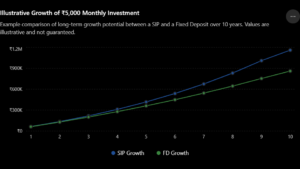
Illustrative comparison showing how a ₹5,000 monthly SIP and FD may grow over a 10-year investment period.
Frequently Asked Questions
Is SIP safer than FD?
No. FDs are safer because returns are fixed. SIPs carry market risk, but they offer higher long-term return potential.
Can I lose money in a SIP?
Yes, mutual funds can fluctuate in value. However, long-term investing has historically reduced the impact of short-term volatility.
Which is better for tax saving?
Long-term equity mutual funds can be more tax-efficient than FDs, whose interest is taxed according to your income tax slab. Check the latest rules on the Income Tax Department website: https://www.incometax.gov.in/.
Should beginners start with SIP or FD?
If you do not yet have an emergency fund, start with an FD. Once you have 3–6 months of expenses saved, begin a SIP for long-term goals.
Need Help Choosing the Right Investment Mix?
At Sah Growth Group, we help Indian professionals and business owners create practical investment strategies that balance wealth creation, tax efficiency, liquidity, and financial security.