
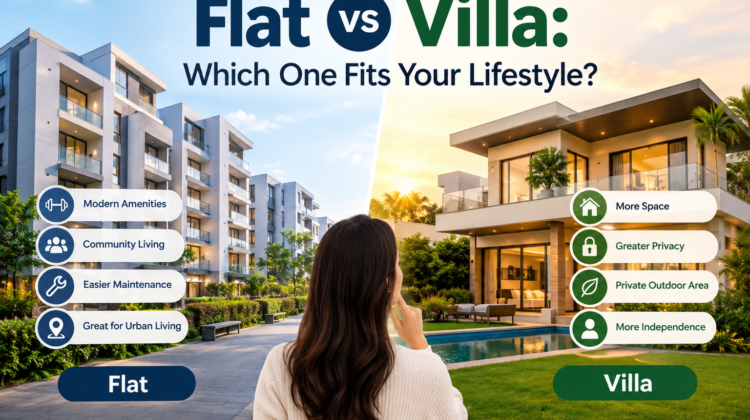
Flat vs. Villa: Which One Fits Your Lifestyle?
When choosing a new home, it is important to consider more than just the price and location. Flat vs. Villa: Which One Fits Your Lifestyle? is a common question among homebuyers because both options offer different benefits. A flat can be a good choice for people who prefer modern amenities, community living, better connectivity, and easier maintenance.
So, Flat vs. Villa: Which one fits your lifestyle?
Let us compare the differences and understand which option fits your lifestyle requirements.
Flat vs. Villa: Understanding the Difference
Before moving on to the key differences between the two, let us first understand the difference between a flat and a villa.
A flat or an apartment is typically a unit which forms a part of a larger building or housing society. In a flat or an apartment complex, the residents can share many facilities like lifts, car parking, security, gardens, etc. A villa home is typically an independent house and may have private parking, a garden, a terrace and/or multiple floors. While a villa is an independent house it is also available in gated communities.
Both flats and villas have their pros and cons and either one of them can fit everyone’s lifestyle and requirement depending on one’s budget and other factors.
Let us now look at the key differences between the two types of properties:
1.Space and Privacy
When comparing Flat vs. Villa: Which One Fits Your Lifestyle?, space and privacy are important factors to consider. Flats are usually part of a residential society, while villas often provide a private entrance, additional outdoor space, and greater separation from neighbours. Families looking for more room and privacy may find a villa more suitable.
2. Maintenance
It is important to consider the maintenance cost of a property as it will have a significant impact on your everyday lifestyle.
While in an apartment society the maintenance of all the common facilities is the responsibility of the society or the managing committee, which is to be borne by all the residents in the form of monthly maintenance charges, in case of a villa the maintenance responsibility lies mainly with the owner.
Therefore, in addition to determining your space & privacy needs it is always a good idea to assess the maintenance cost and the ease of maintenance before arriving at a decision.
3. Amenities
Most modern apartment societies come with a variety of facilities such as swimming pools, fitness centre, clubhouses, kids’ play areas, walking tracks, sports complex, community halls, landscaped gardens and so on and so forth. These are all very appealing for families and for individuals looking to build a social circle.
Most gated villa communities provide a variety of shared facilities but the variety and the quality of the facilities may vary from one project to another. Therefore, it becomes very important to ask questions about facilities, maintenance charges, usage guidelines, accessibility, etc.
4. Security
Most apartment societies have a 24×7 security staff, CCTV coverage, visitor management system, and controlled entry/exit gates. Most gated villa projects also come with similar security features. However, an independent villa might require the owner to arrange for additional security arrangements.
While comparing a flat vs. a villa for purchase, it becomes necessary for the buyer to check the security facilities provided at the property under consideration.
5. Budget & Ownership
Your budget plays a significant role in determining your property selection criteria. When looking at a flat vs. a villa it is important to not only compare the property price but other associated costs like:
• Property price
• Home loan interest
• Stamp duty
• Registration charges
• Maintenance
• Property taxes
• Interior costs
• Parking charges
• Repairs & renovations
A flat is available in different price ranges, whereas a villa tends to cost more due to its higher built-up area and the larger land parcel that it occupies. However, this may vary from one city to another as well as project to project.
6. Location & Connectivity
The location of the property is extremely important and should ideally be within one’s budget range. A flat located in city areas can provide better opportunities and accessibility to one’s daily needs.
A villa may provide greater space and privacy but it might not be easily accessible to all city facilities that one would need on a regular basis.
Therefore, it is essential to look at the connectivity to one’s workplace, school, hospitals, shopping complexes, and other day-to-day necessities. One should also account for peak hour traffic and travel time.
While a bigger house or villa might sound appealing, it does not mean that it will be more convenient or easily accessible than a flat if the flat is located at a more accessible location.
7. Lifestyle & Family Needs
The family structure will also be a determining factor in one’s decision-making process. For an individual living alone or for a couple, a flat may be very convenient whereas a villa will give more space and more privacy. On the other hand, a family living in a villa may get more benefits.
One should also think about the future and about the number of people that one’s family is expected to grow to as one may look for more space if one’s family grows.
8. Investment & Rental Demand
If you are an investor looking to buy a property to keep as an investment or to rent out, one should look at not only the property’s price, location and lifestyle suitability but also look at the property demand in the area.
There are several such influencing factors such as:
• Rental demand in the locality
• Employment hubs
• Schooling facilities
• Infrastructure development
• Property price
• Maintenance charges
While flats have a greater rental demand in localities where they are in demand among professionals and families, a villa tends to attract different kinds of buyers and renters.
The resale and rental demands of a flat or a villa can vary according to their location and other factors.
Therefore, it is necessary to conduct local research in the area of one’s choice before making any investment decisions.
Flat vs. Villa: Which one fits your lifestyle?
When looking at the flat vs. villa debate, one should keep in mind, not only the square footages, but what is it that one wants out of the property.
A flat can be very convenient for someone who wishes to live in a society with shared facilities whereas a villa can be more suitable for someone who wants more privacy.
One should also evaluate their current financial situation and future goals.
Let us now draw up a comparison between a flat and a villa on different parameters:
Flat Villa Space Usually compact and well planned Generally more spacious Privacy Moderate Generally higher Maintenance Managed by society More individual responsibility Amenities Available in larger societies Depends on community Security Managed by society Depends on community Outdoor space Balcony/terrace may be available Garden/terrace may be available Customisation May have society restrictions More flexibility Community Living Strong Depends on community Purchase Cost Wide range Generally higher Location Urban areas Common in suburbs
How to Make the Right Decision
Before buying a flat or a villa it is a good idea to make a checklist based on what one is looking for in a home and what one is willing to sacrifice. Here is a sample checklist:
1. What is my maximum purchase budget?
2. How much space does my family need?
3. Do I prefer privacy or community living?
4. How much maintenance can I manage?
5. Do I need a private garden or parking area?
6. How important are amenities?
7. How far is the property from work and school?
8. What are the monthly ownership costs?
9. What are the property’s resale and rental prospects?
10. Does the property fit my long-term plans?
Final Thoughts
It is often tricky to decide which one is a better option between a flat or a villa. Whereas a flat can provide convenience, community facilities, security features and urban connectivity, a villa can provide more space and an independent living experience.
Frequently Asked Questions
Is a flat better than a villa?
It depends on the buyer’s requirements. A flat may be suited for people who prefer convenience, shared amenities, community living, and urban connectivity whereas a villa may be preferred by those looking for more space and privacy.
Is a villa more expensive than a flat?
Villas can have a higher purchase price as they tend to provide more built-up space and land. However, prices vary significantly by location, property size, project, and specifications.
Which is easier to maintain, a flat or villa?
A flat can be easier to maintain as most of the common facilities are managed by the housing society. A villa owner may have greater responsibility for the property’s exterior, garden, etc.
What should I check before buying a flat?
One should check the project’s legal approvals, ownership documents, applicable RERA information, construction, maintenance charges, facilities, location, possession information, and purchase costs.
Making the Final Decision
There is no single answer for every homebuyer. Flat vs. Villa: Which One Fits Your Lifestyle? ultimately depends on your personal priorities and long-term plans. If you value convenience, community living, and shared amenities, a flat may suit you. If you prefer privacy, larger spaces, outdoor areas, and greater independence, a villa may be worth considering.